A beautiful website can still be a failing one
Beautiful websites still fail when strategy, speed, SEO and follow up are missing. Here is what a business website needs beyond good looks.
For: Businesses with a good looking site and few results
Lorenzo DevereuxFounder & CEO, Devereux Digitals
Good design matters. It builds trust in seconds and makes a business look established. Yet plenty of beautiful websites still fail to bring in business.
That’s because design is only one layer. A website that grows a business also needs a strategy, a solid technical foundation, visibility in search and a system for what happens after someone enquires.
The layers of a website that works
- Strategy
- Content
- Design
- Technology
- Follow up systems
Strategy: who it is for and what it must do
Without a clear audience and goal, design decisions become matters of taste. With them, every element can be judged on whether it helps the right visitor take the right action.
Content that answers real questions
Customers search for answers: prices, timelines, comparisons and how something works. Pages that answer those questions clearly convert and rank better than pages filled with generic claims.
The invisible technical foundation
- Speed: fast pages keep visitors and are favoured by search engines.
- Accessibility: readable contrast, keyboard navigation and alt text widen your audience.
- Security: maintained platforms, HTTPS and backups protect your reputation.
- Search basics: titles, descriptions, headings, structured data and a sitemap.
Systems for what happens after the enquiry
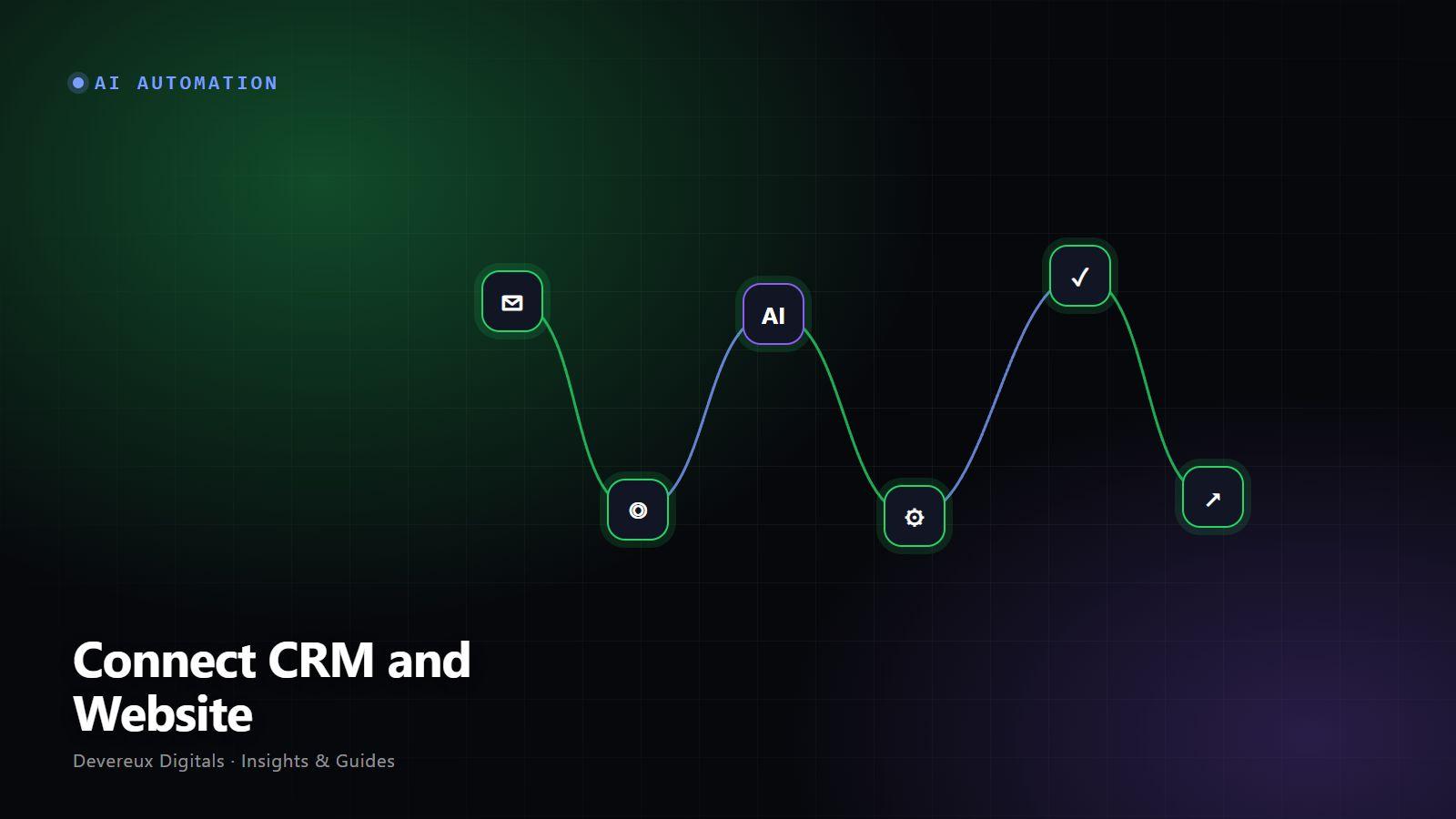
Many leads are lost after the form rather than before it. Enquiries land in a shared inbox, nobody owns them and replies go out days later. Connecting your website to a CRM or automated follow up gives every lead an instant acknowledgement and a named owner.
- Form submitted
- Lead saved to CRM
- Instant confirmation
- Owner notified
- Follow up scheduled
A living asset
The businesses that get the most from their websites review them regularly, adding new case studies, updated pricing, fresh answers to common questions and small conversion tests. A website that never changes slowly falls behind.
Illustrative example: the beautiful site that quietly lost leads
Imagine an interior design studio with a stunning portfolio site: full screen photography, elegant typography and smooth animations. Visitors love it. Yet enquiries are low, and the few that arrive come through a form that emails a shared inbox nobody checks daily.
Look beneath the surface and the problems appear. The images are so large that pages load slowly on phones. Project pages have no text, leaving search engines nothing to rank. There’s no indication of budget or process, so visitors are unsure whether to enquire. And the enquiries that do arrive wait days for a reply.
Keeping the design while compressing images, adding short project descriptions, a clear process and price guidance, and connecting the form to a CRM with instant acknowledgements would address each layer without losing what makes the site beautiful.
Common mistakes to avoid
- Treating the launch as the end of the project.
- Ignoring speed because the site looks fine on office WiFi.
- Sending enquiries to an unmonitored inbox.
- Relying on images alone with no searchable text.
How to measure success
Look beyond visual feedback. Track mobile page speed, organic impressions and clicks in Search Console, enquiry conversion rate and the average time between an enquiry arriving and the first reply.
If the design is strong but these numbers are weak, the problem sits in one of the invisible layers, and that’s where to invest next.
Your action checklist
- Check speed on a phone using mobile data.
- Make sure every key page has meaningful text.
- Connect your forms to a CRM or tracked inbox.
- Set an internal response time target.
- Review the site quarterly.
Questions to ask before you start
- Does the site load quickly on a phone using mobile data?
- Can people find us when they search for what we do?
- Where do enquiries go, and who replies to them?
- When did we last update our proof, pricing and FAQs?
Tools and technologies
- Google Search Console
- PageSpeed Insights
- HubSpot
- Zapier or Make
- Google Analytics 4
Frequently asked questions
Conclusion
Great websites look good and work hard. They rest on a clear strategy, useful content, a fast and secure foundation, and systems that catch every lead.